
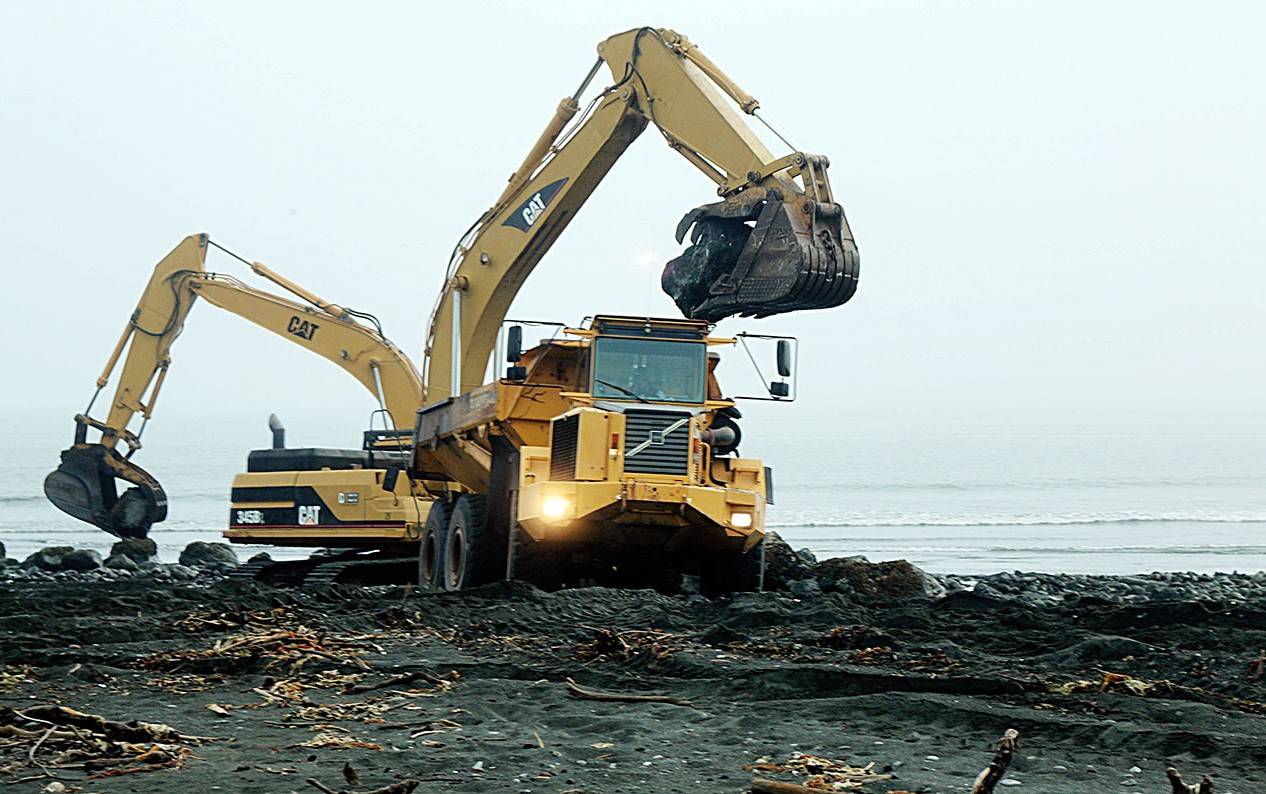
PORT ANGELES — It didn’t take long for a half-mile section of eroded beach to be transformed after derelict armor was removed east of the Elwha River mouth.
In one tidal cycle, parts of the sediment-starved, coarse-cobble shoreline were covered by 6 feet to 10 feet of sand as the Beach Lake Acquisition and Restoration project was put into motion last weekend.
“It was an incredible beach transformation, literally overnight,” said Jamie Michel, nearshore biologist with the Coastal Watershed Institute and project manager.
Nearly 3,000 cubic yards of riprap and concrete slab were removed from the shore as part of a $2 million, multi-agency effort to restore the beach and coastal wetlands for fish and wildlife habitat.
Once completed in about a year, the project also will provide public access to the ever-changing Elwha nearshore through the purchase of a 23-acre parcel adjacent to the Lower Elwha Klallam Tribal Reservation.
“It’s a gorgeous beach now,” said Anne Shaffer, executive director and lead scientist of the Port Angeles-based Coastal Watershed Institute.
“It’s the latest illustration of how quickly an ecosystem recovers once you remove the limiting process.”
The old armor had been keeping fine sands and woody debris suspended by wave action, preventing natural beach formation.
Sediment from the Elwha River, which is driven by tides, prevailing winds and waves, can now settle on the beach with the armor out of the way.
“Now we’ve got the right type of beach process happening,” Michel said.
“From a habitat function standpoint, it’s really important to the young, juvenile salmon that are migrating out of the Elwha.”
The new beach is prime spawning habitat for surf smelt and ideal for forage fish, Shaffer said.
Scientists expected the beach to change after Bruch & Bruch Construction, the Port Angeles contractor hired for the job, removed the armor Aug. 13-19.
But even the experts were surprised by how quickly the beach was transformed and the shorebirds and otters returned.
“We knew there would be a change, but not in that fashion,” Shaffer said.
Last February, the Coastal Watershed Institute and state Department of Ecology received a $1 million grant from the U.S. Fish and Wildlife Service for the Beach Lake Acquisition and Restoration project.
Additional funding came from the state Salmon Recovery Funding Board and Puget Sound Partnership, which listed the project as its top priority in a recent ranking.
Key partners include the Lower Elwha Klallam tribe, North Olympic Land Trust, North Peninsula Building Association, Built Green of Clallam County, Surfrider Foundation, Olympic Peninsula Audubon Society, Patagonia, Lighthawk, Ecotrust and North Olympic Peninsula Lead Entity for Salmon, Michel said.
The derelict armor removal comes two years after the last of the Elwha River dams was taken out.
The National Park Service spearheaded a $325 million river restoration project highlighted by the removal of the century-old Elwha and nearly-century-old Glines Canyon dams.
The Coastal Watershed Institute, or CWI, is studying changes to the landforms and aquatic life in and around the mouth of the Elwha River.
Although most of the derelict armor has been removed, the Beach Lake Acquisition and Restoration project is not yet complete.
Michel said another $700,000 is needed to remove structures and remaining riprap from the site, to revegetate an old cow pasture, to provide parking and to install interpretive signs, among other final tasks.
“Once we get it restored, the intent is to turn it over to the tribe and they will manage it for public access,” Shaffer said.
Some of the old armor was used as a barrier around the site. Much of the rest created a “small- to medium-sized mountain of rock” to be used later in the project or sold to lower the cost, Michel said.
The land, which is being held by the Coastal Watershed Institute, was purchased from a private family.
“We are pleased for this unique property to be conserved for all to enjoy,” said Rick Phillips, a representative of the property owners, in a CWI news release.
Michel said the Lower Elwha Klallam tribe has been a “great partner” in this project.
“We’re really thankful for their involvement,” he added.
The armor was placed on the beach beginning in the 1950s to stem rapid erosion east of the Elwha River mouth. The shoreline was eroding because naturally flowing sediment was blocked by the two dams, Michel said.
“Now, the exact opposite is happening,” he said.
The derelict armor was strewn across a wide section of beach ranging from 8 feet above the low tide mark to 3 feet below it.
Bruch & Bruch, which has experience working in tidal zones, was “aces” on the job, Michel said during a Friday site visit.
With most the armor gone, the beach is now “looking like the new beaches that formed at the mouth of the [Elwha] River.”
“I think it’s a big win for people that go out and use the beach,” Michel said.
“It was kind of a win-win for everyone.”
_________
Reporter Rob Ollikainen can be reached at 360-452-2345, ext. 56450, or at rollikainen@peninsuladailynews.com.
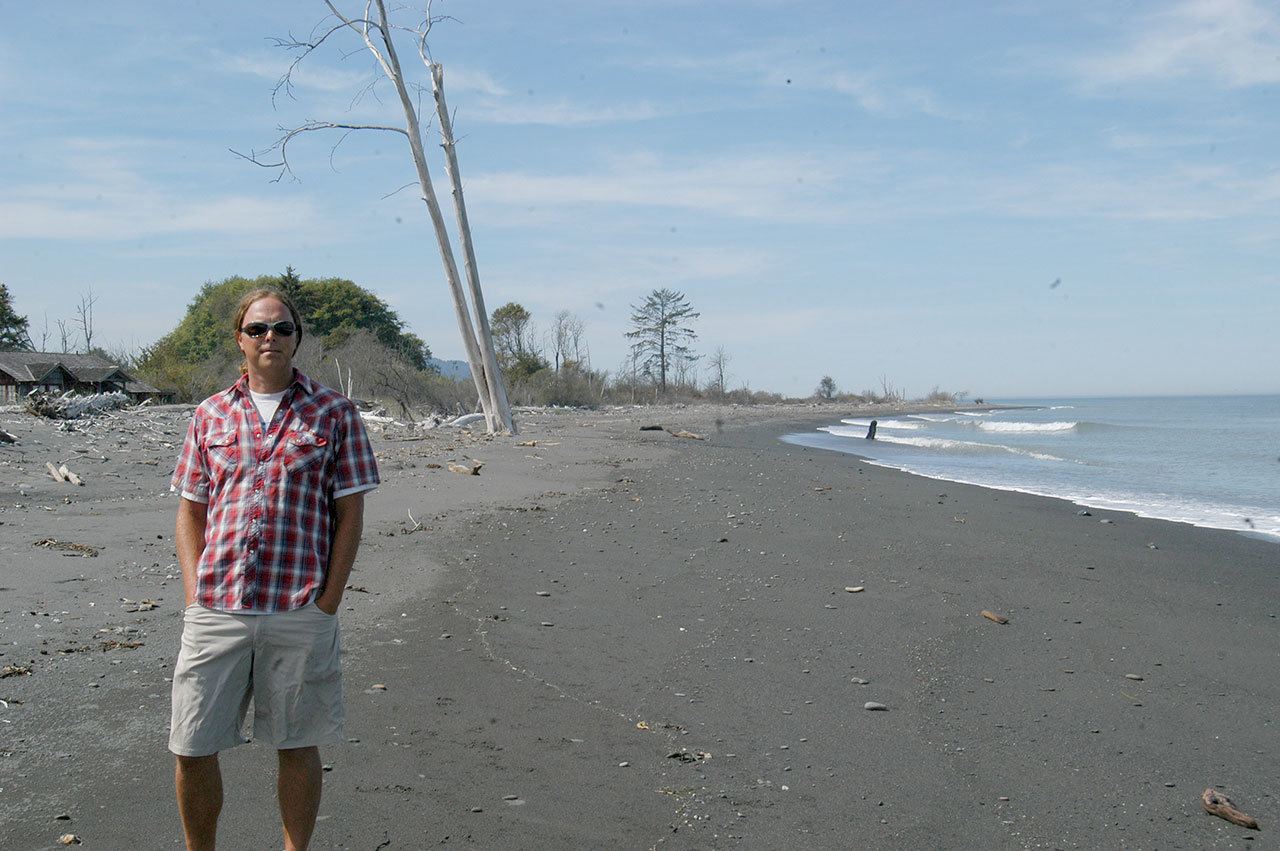
Jamie Michel, nearshore biologist with the Coastal Watershed Institute, stands on a newly formed beach east of the Elwha River Mouth on Friday. (Rob Ollikainen/Peninsula Daily News)
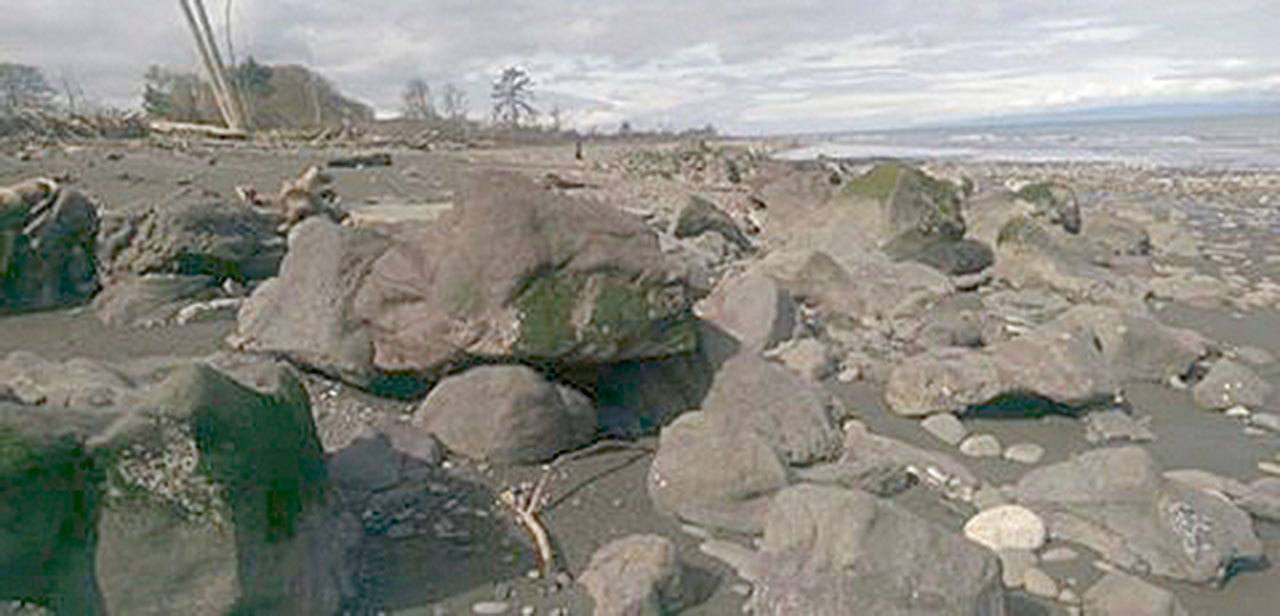
The beach lake restoration site before restoration. (Jamie Michel/Coastal Watershed Institute)
