
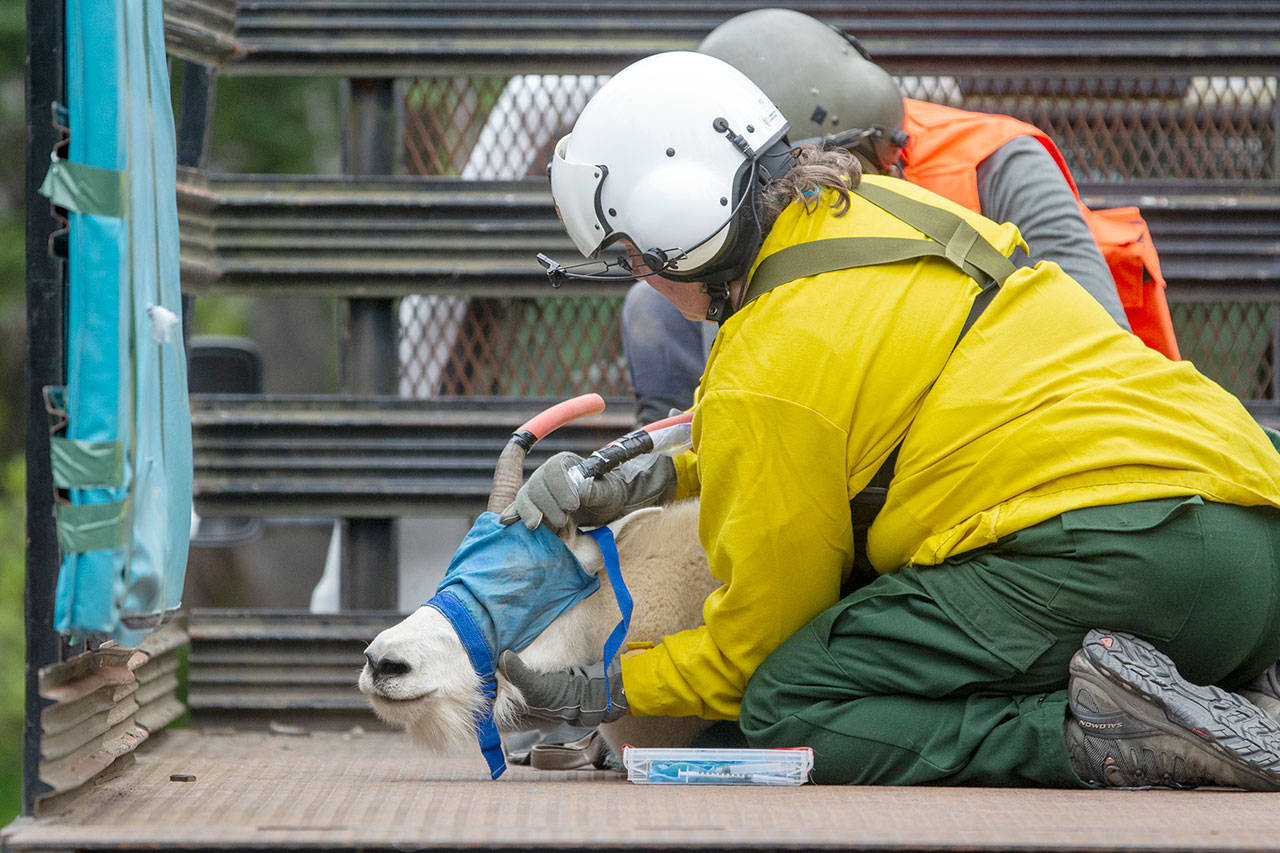
Capture and translocation operations are now complete for 2019, officials with several national parks and state Department of Fish & Wildlife said Thursday.
In all, 101 mountain goats were removed from Olympic National Park and Olympic National Forest to the northern Cascade Mountains, officials said.
Since September 2018, a total of 275 mountain goats have been translocated.
An additional two-week capture and translocation period is planned for summer 2020.
The effort is a partnership between the National Park Service, state Department of Fish & Wildlife and the U.S. Forest Service to re-establish and assist in connecting depleted populations of mountain goats in the Washington Cascades, while also removing non-native goats from the Olympic Mountains.
Though some mountain goat populations in the North Cascades have recovered since the 1990s, officials said, the species is absent or rare in several areas of its historic range. Mountain goats were introduced to the Olympics in the 1920s as game animals.
Since then the goats have become so plentiful that officials say the goats impact the fragile alpine and sub-alpine ecosystem and that they have become too comfortable around humans.
Some goats have become aggressive in their search for salts in human urine and sweat.
Bob Boardman, a Port Angeles man, was killed by a goat that gored him as he hiked Klahhane Ridge in October 2010.
A total of 22 mountain goats were removed from Olympic National Forest in August; 16 mountain goats were removed from the Mount Ellinor and Mount Washington area and six from The Brothers Wilderness.
In addition to the 101 mountain goats released in the North Cascades, seven adult goats died during capture while four animals that could not be captured safely were “lethally removed,” park officials said.
Ten mountain goat kids were transferred as a group to Northwest Trek Wildlife Park for stabilization, acclimation and socialization. One kid will join six other goats in the wildlife park’s 435-acre free-roaming area; the other nine kids will move to new homes at other zoos.
A total of 16 mountain goat kids have been given permanent homes in zoos: six in 2018 and 10 in 2019.
Leading Edge Aviation, a private company that specializes in the capture of wild animals, conducted aerial capture operations through a contract.
The helicopter crew used immobilizing darts and net guns to capture mountain goats and transported them in specially made slings to the staging areas located at Hurricane Ridge in Olympic National Park and the Hamma Hamma area in Olympic National Forest.
“We were very fortunate to have a long stretch of good weather in August which enabled us to safely catch mountain goats throughout the Olympics and make good progress towards reaching our translocation goals,” said Patti Happe, Wildlife Branch chief at Olympic National Park.
Volunteers from the Point No Point Treaty Council, Quileute Tribe, Quinault Indian Nation, Makah Tribe, Lower Elwha Klallam Tribe, Skokomish Indian Tribe and Port Gamble S’Klallam Tribe also assisted at the staging areas in the Olympic Mountains.
“Many thanks to all the volunteers and cooperators, including several biologists and former National Park Service staff who came out of retirement to assist with the project,” Happe said.
Animals were examined and treated by veterinarians before volunteers working with the state transported them to pre-selected staging areas in the North Cascades. The mountain goats were transported in refrigerated trucks to keep them cool.
In May 2018, the National Park Service released the final Mountain Goat Management Plan that outlines efforts to remove the estimated 725 mountain goats on the Olympic Peninsula. Both the plan and the associated environmental impact statement were finalized after a public review process that began in 2014.
For more information about mountain goats in Washington state, see tinyurl.com/PDN-goatsinstate.
For more information and updates on the project, visit tinyurl.com/PDN-goatcapture.
