
By Phuong Le
The Associated Press
SEATTLE — A bill that would make it easier to kill sea lions that feast on imperiled salmon in the Columbia River has cleared the U.S. Senate.
State wildlife managers said rebounding numbers of sea lions are eating more salmon than ever and their appetites are undermining billions of dollars of investments to restore endangered fish runs.
Senate Bill 3119, which passed Thursday by unanimous consent, would streamline the process for Washington, Idaho, Oregon and several Pacific Northwest Native American tribes to capture and euthanize potentially hundreds of sea lions found in the river east of Portland, Ore.
Sen. Jim Risch, an Idaho Republican who co-sponsored the bill with senators from all three states, said the legislation would help ensure healthy populations of salmon for years to come.
“As endangered salmon face extinction, we must take steps to protect them,” Sen. Maria Cantwell, a Washington Democrat, said in a statement.
The Senate bill is similar to one passed by the U.S. House in June and sponsored by Reps. Jaime Herrera Beutler, a Washington Republican, Kurt Schrader, an Oregon Democrat, and others.
The House will have to consider the Senate’s bill, or vice versa, before it heads to President Donald Trump for consideration.
“We have reason to believe they will by the end of the year,” said Kaylin Minton, communications director for Risch.
Supporters, including the governors of Oregon, Washington and Idaho, fishing groups and tribes, said the bill will give wildlife managers greater flexibility in controlling California sea lions that dramatically increased from about 30,000 in the 1960s to about 300,000 under the 1972 Marine Mammal Protection Act.
Critics called it ill-conceived and said it won’t solve the problem of declining salmon, which also face other problems such as habitat loss and dams.
“This bill changes the core protective nature of the Marine Mammal Protection Act by allowing for the indiscriminate killing of sea lions throughout the Columbia River and its tributaries,” Naomi Rose, marine mammal scientist for Animal Welfare Institute, said in a statement.
Washington, Idaho and Oregon wildlife managers currently have federal authorization to kill problem sea lions that eat salmon in the Columbia River near Bonneville Dam east of Portland.
But they must first go through a lengthy process to identify and document specific sea lions that cause problems, including observing them eating a salmon and using non-lethal hazing measures on them.
Both the House and Senate bills would remove those requirements, so states and several Native American tribes could get a federal permit to remove any sea lion east of the Interstate 205 bridge that connects Vancouver with Portland, as well as in tributaries of the Columbia River where there are federally protected fish.
Several Native American tribes, including the Yakama Nation, Warm Springs, Umatilla and Nez Perce tribes, also would be granted authority to manage sea lions.
Under both bills, the total number of sea lions removed cannot exceed 10 percent of a specified level, called the potential biological removal.
For California sea lions, for example, that limit would be no more than 920 animals.
Nate Pamplin, policy director of Washington Department of Fish and Wildlife, said the actual number of animals removed would be much lower because there aren’t that many eligible to be removed.
While there are several thousand California sea lions in the Columbia River estuary, only about 200 to 300 swim more than 100 miles upriver from the Pacific Ocean and would be eligible for removal, state wildlife officials said.
An orca task force convened by Washington Gov. Jay Inslee also backed the legislation to boost the fish for the struggling population of southern resident killer whales.
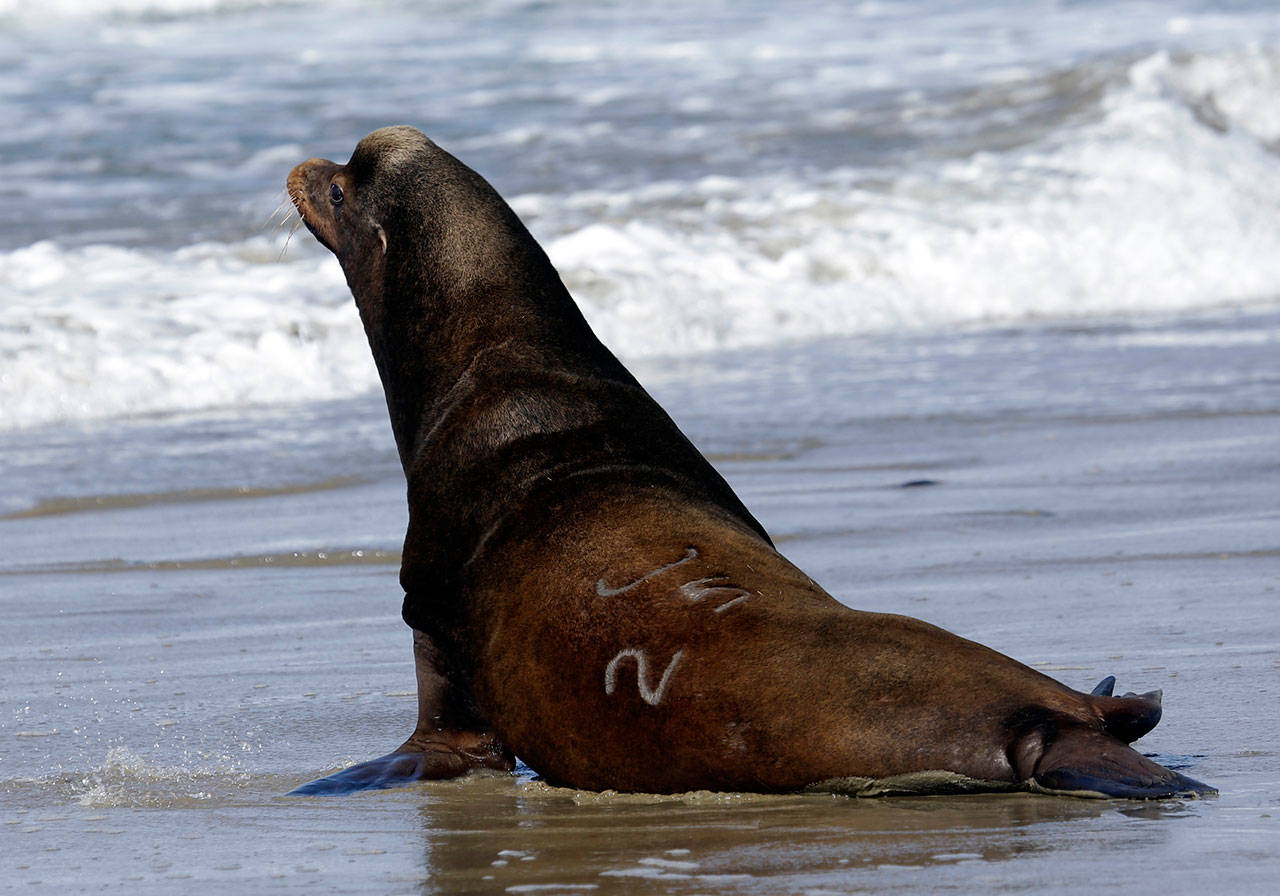
In this March 14 file photo, a California sea lion designated #U253 heads toward the Pacific Ocean after being released in Newport, Ore. (Don Ryan/The Associated Press)
