
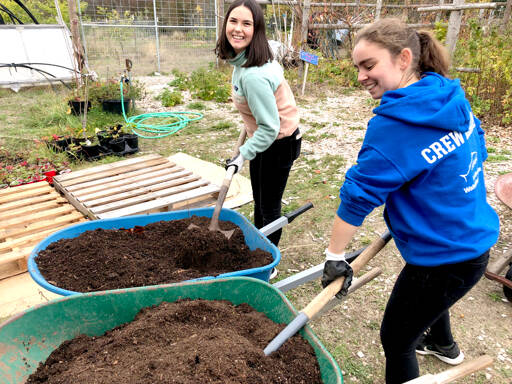
QUILCENE — Three high school student participants in the Youth Environmental Stewards program are helping the staff of Northwest Watershed Institute remodel the native plant nursery at the Tarboo Wildlife Refuge.
Jeannette Patric of Port Townsend serves as project manager. Viola Frank of Chimacum manages the design-build-installation process and Hailey Gallagher of Port Townsend is propagating 1,500 native plants for other students to pot up and plant at future restoration projects along Tarboo Creek and Dabob Bay, according to Jude Rubin, coordinator of the Youth Environmental Stewards (YES) program, which is mentoring the students along with Wesley Meyers, NWI’s incoming director of stewardship.
By mid-April, the Northwest Watershed Institute will have a completely refurbished native plant nursery.
A combined grand re-opening, native plant nursery work party and YES Program Alumni Reunion is scheduled for Saturday at Tarboo Wildlife Refuge.
Former YES Program participants and supporters can contact jude@nwwatershed.org for details about attending.
For Patric and Gallagher, the project fulfills the senior project requirement at Port Townsend High School, while Frank — who attends Chimacum High School — participated purely as a volunteer, Rubin said.
The native plant nursery began in 2005 simply as a site to pot up extra bare-root plants and store native plants prior to the planting season. Over time, the nursery became prone to weeds. It was beginning to deteriorate, Rubin said.
“The goal is to improve efficiency to grow more native plants at Tarboo Wildlife Preserve (TWP), which is also a teaching base for the students and volunteers who participate in native plantings and ecological restoration,” Patric said.
“Native plants grown locally in the nursery will improve salmon and wildlife habitat, help reduce competition from non-native plants, and larger trees will absorb carbon dioxide emissions, which helps mitigate the impacts of climate change,” she added.
Patric said she was inspired to work on the project because of her experiences when she was younger in the Plant-A-Thon and many habitat restoration projects through the YES Program.
Her work on the nursery project “will help the success of these programs for future students,” she said.
“The nursery will be a base for teaching the YES Program and for crew leaders learning plant identification for the NWI’s annual Plant-A-Thon event,” Rubin said.
“A revamp of the nursery was very necessary, and it’s exciting to know it will serve people and the planet for many years to come,” she added.
Frank said that two years ago, she, her sister Eugenia, a few other YES students and Rubin tried to fix up the nursery, but it needed a bigger overhaul.
In September, Rubin and the students toured more-established plant propagation facilities, including the North Olympic Salmon Coalition’s Native Plant Nursery and the Olympic National Park Matt Albright Nursery.
Soon afterward, Gallagher scouted the shores of Dabob Bay, collecting hundreds of seeds of Bigleaf Maple (Acer macrophyllum) and live stakes of hardhack, (Spiraea douglasii), both of which she propagated at Shooting Star Farm in Port Townsend.
The hardhack sprouted easily from cuttings, but the maples were inconsistent, Rubin said, adding that Hailey used different storage and propagation conditions, so she is evaluating the outcomes to learn more about what worked and what didn’t.
“NWI will experiment with maples to test their resistance to drought and heat waves like the ones we’ve been experiencing in recent years,” Rubin said.
“And NWI will try planting hardhack to combat Reed Canary Grass, which chokes out streams and wetlands,” Rubin said. “It was great to have Hailey work at a scale that makes an impact. With the plants she has grown, NWI will be able to do ground trials for future restoration.
The next step was to design the facility, create a budget and procure materials.
“They worked with staff to think through every detail of how the gate swings, where the truck backs in, where sun and shade are on site, irrigation, etc. — it was an engineering puzzle,” Rubin said.
Once NWI agreed to the design and materials, the three students worked during the winter at the Frank family’s nearby workshop. There, Art Frank showed them how to refurbish old, donated lumber and they built the plant potting table and gate for the nursery.
In March, the team again coordinated closely with NWI staff, who graded the site. Together they installed structures, spread gravel, laid down barrier cloth and installed a new fence.
“It’s taken several years to get this project onto the front burner. But with help from the Frank family and NWI’s professional restoration crew, these three [Patric, Frank and Gallagher] got 100 percent behind it, and made it happen. They turned it into a beautiful place to work,” Rubin said.
Since 2001, NWI has twice expanded the Dabob Bay Natural Area Preserve, created the Tarboo Wildlife Preserve and conserved upwards of 2,400 acres.
With school children and their families, NWI has replanted more than 315 acres through the annual Plant-A-Thon event.
As a last step, students wrote articles and started a crowd-funding campaign to pay for materials.
To donate to the nursery project and the YES program, see www.nwwatershed.org.
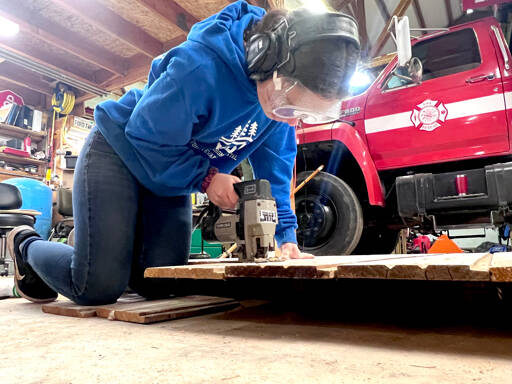
Student design and construction manager Viola Frank works on a new potting table for Northwest Watershed Institute native plant nursery. (Northwest Watershed Institute)
