
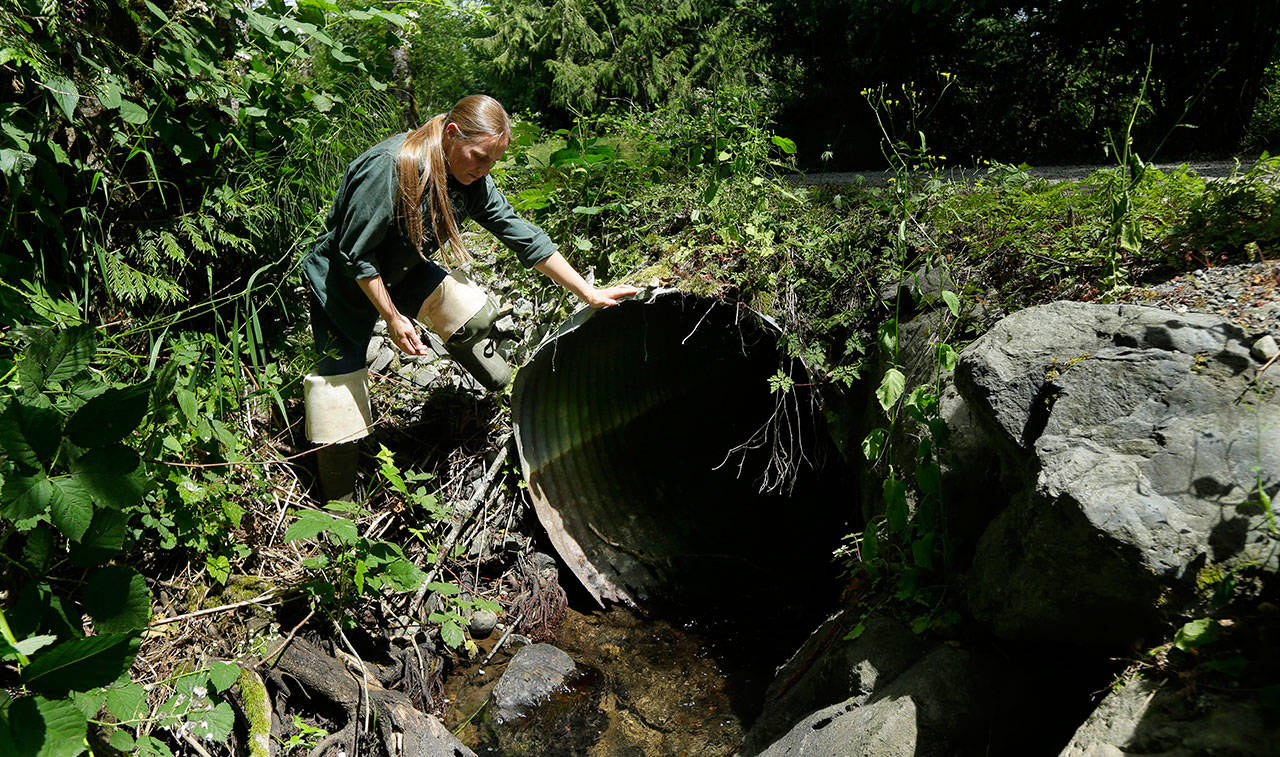
Melissa Erkel, a fish passage biologist with the state Department of Fish and Wildlife, looks at a culvert along the north fork of Newaukum Creek near Enumclaw on June 22, 2015. (Ted S. Warren/The Associated Press)

Melissa Erkel, a fish passage biologist with the state Department of Fish and Wildlife, looks at a culvert along the north fork of Newaukum Creek near Enumclaw on June 22, 2015. (Ted S. Warren/The Associated Press)

Washington loses legal fight, might pay up to $2 billion to save salmon

By Phuong Le

The Associated Press

SEATTLE — Washington state has lost a major legal battle which could force it to spend nearly $2 billion to restore salmon habitat by removing barriers that block fish migration.

A panel of the 9th U.S. Circuit Court of Appeals last year affirmed a lower court’s 2013 ruling ordering the state to fix or replace hundreds of culverts — large pipes that allow streams to pass beneath roads but block migrating salmon.

Idaho and Montana joined Washington state in asking the appeals court to reconsider the case. The court declined to do so Friday, but several judges dissented from that decision, saying it should be reconsidered because of its significance.

“This is a win for salmon, treaty rights and everyone who lives here,” Lorraine Loomis, chair of the Northwest Indian Fisheries Commission, said in a statement.

The group represents 21 tribes in western Washington that challenged the state over the culverts in 2001, part of decades-long litigation over tribal fishing rights.

“Fixing fish-blocking culverts under state roads will open up hundreds of miles of habitat and result in more salmon,” she said.

Messages left with a spokesman for the state Attorney General’s Office were not immediately returned Friday.

Sought rehearing

Washington had sought a rehearing, arguing in part that the court’s decision forces the state to spend billions to replace culverts that in some cases wouldn’t have an impact on salmon because there were other barriers upstream or downstream that completely block salmon.

It also said the decision would have broad implications for other land and water use management in the Northwest.

“Ordering a state to spend money on something that will make no difference is an abuse of discretion,” the state argued in asking for another hearing.

Culverts, or concrete pipes or steel structures, can be a problem for fish in several ways.

Among them, the angle of the structure may be too steep for fish to navigate, or stream flows running through a small pipe can be too fast for fish to swim upstream.

The U.S. government sued Washington in 2001 on behalf of the 21 tribes to force it to replace the culverts with structures that allow fish to pass through.

Seattle U.S. District Judge Ricardo S. Martinez held that fish-blocking culverts contribute to diminished salmon runs by blocking access to miles of suitable streams. In 2013, he ordered the state to replace hundreds of the highest-priority culverts within 17 years.

The state appealed, arguing that its treaties with the tribes created no obligation to restore salmon habitat.

In declining to reconsider, the panel said Friday that the lower court properly found the state violated the treaty rights of tribes to fish by building and maintaining salmon-blocking pipes under those roads.

Ample evidence

It said there’s ample evidence that fixing the fish-blocking barriers will benefit salmon runs, resulting in more harvestable salmon for the tribes.

But several judges disagreed, said the panel’s opinion “sets up precedent that could be used to challenge activities that affect wildlife habitat in other western states.”

They said the panel’s decision upholds an overbroad injunction that requires the state “to spend millions of dollars on repairs that will have no immediate effect on salmon habitat.”

More in News

Climate action group is guiding reduction goals

Reduced emmissions require reduced transportation footprint

County, Port Angeles to rebid public safety building

Three bids rejected due to issue with electrical contractor

Aliya Gillet, the 2025 Clallam County Fair queen, crowns Keira Headrick as the 2026 queen during a ceremony on Saturday at the Clallam County Fairgrounds. At left is princess Julianna Getzin and at right is princess Jasmine Green. The other princesses, not pictured, are Makenzie Taylor, Molly Beeman and Tish Hamilton. (Dave Logan/for Peninsula Daily News)
Clallam County royalty crowned for annual fair

Silent auction raises funds for scholarships

Port Angeles Community Award recipients gather after Saturday night’s annual awards gala. From left, they are Frances Charles, Lower Elwha Klallam Tribe, Organization of the Year; Kyla Magner, Country Aire, Business of the Year; Amy Burghart and Doug Burghart, Mighty Pine Brewing, Emerging Business of the Year; Rick Ross, Educator of the Year; Kayla Fairchild, Young Leader of the Year; John Fox, Citizen of the Year. (Paula Hunt/Peninsula Daily News)
Community leaders honored at annual awards banquet

Fox named Citizen of Year for support of athletic events

Clallam County commissioners consider options for Owens

Supporters advocate for late state justice

Respiratory viruses are rising on the Peninsula

Health officer attributes increase to mutation of type of flu in circulation

Deadline for Olympic Medical Center board position is Thursday

The deadline to submit an application for the Position… Continue reading

No weekly flight operations scheduled this week

No field carrier landing practice operations are scheduled for aircraft… Continue reading

Some power restored after tree falls into line near Morse Creek

Power has been restored to most customers after a… Continue reading

Wendy Rae Johnson waves to cars on the north side of U.S. Highway 101 in Port Angeles on Saturday during a demonstration against U.S. Immigration and Customs Enforcement operations in Minnesota. On the other side of the highway is the Peninsula Handmaids in red robes and hoods. (Dave Logan/for Peninsula Daily News)
ICE protest

Wendy Rae Johnson waves to cars on the north side of U.S.… Continue reading

Jamestown Salish Seasons, a psychiatric evaluation and treatment clinic owned and operated by the Jamestown S’Klallam Tribe, tentatively will open this summer and offer 16 beds for voluntary patients with acute psychiatric symptoms. (Jamestown S’Klallam Tribe)
Jamestown’s evaluation and treatment clinic slated to open this summer

Administrators say facility is first tribe-owned, operated in state

North Olympic Library System staff closed the Sequim temporary library on Sunday to move operations back to the Sequim Avenue branch that has been under construction since April 2024. (North Olympic Library System)
Sequim Library closer to reopening date

Limited hours offered for holds, pickups until construction is complete